

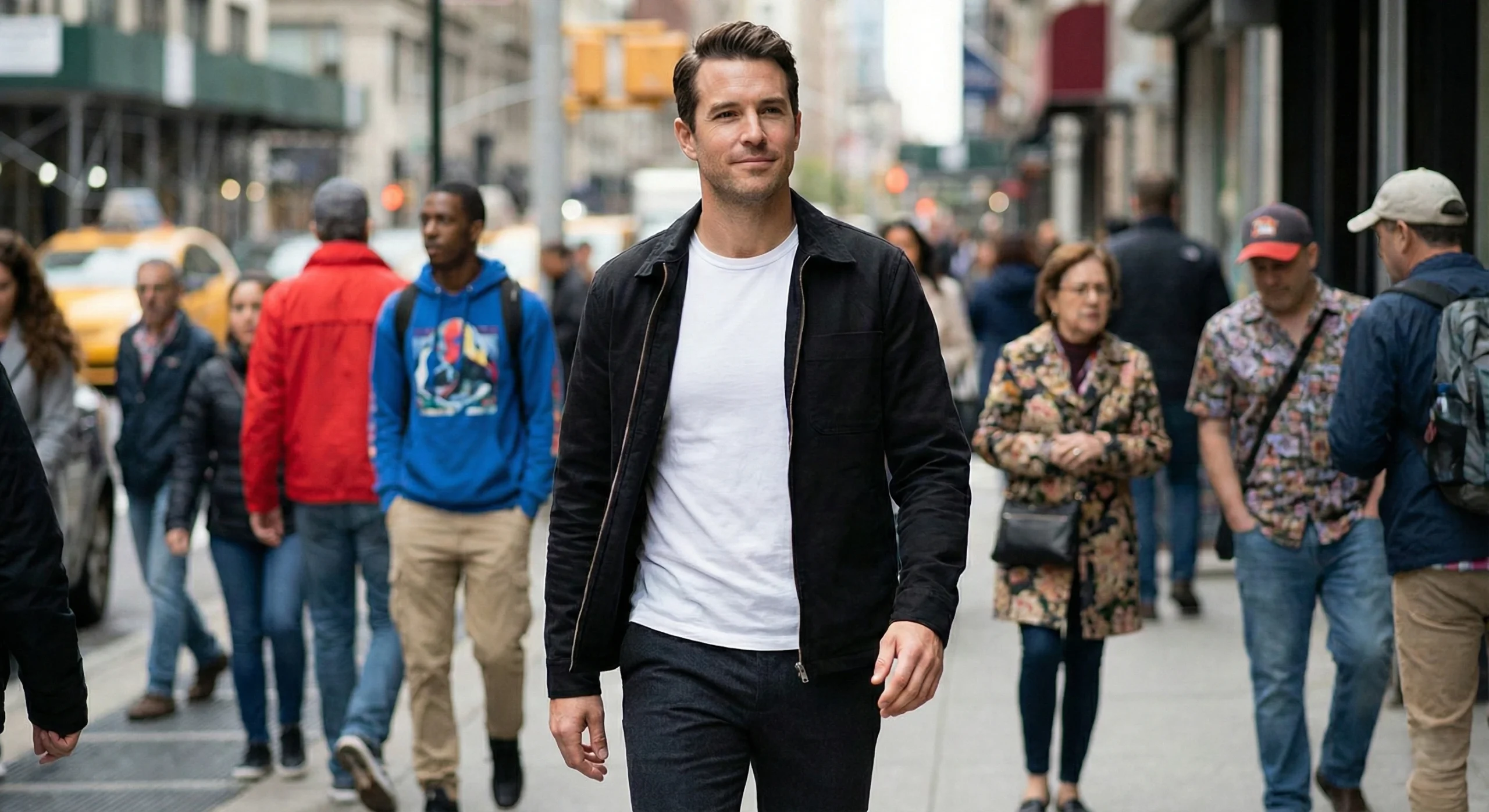
The Cultural Shift Away From Attention and Toward Ease
For a long time, fashion rewarded volume. Loud logos, bold graphics, exaggerated silhouettes, and trend-heavy styling dominated because visibility was currency. To be seen was to matter. Clothing became a tool for signaling identity as loudly as possible, especially in environments saturated with competition for attention.
That era is slowly losing its grip.
Not because people care less about how they look, but because the cost of constant visibility has become exhausting. Loud fashion doesn’t just attract attention from others; it demands attention from the person wearing it. It requires awareness, maintenance, and performance. And in a world already overloaded with stimuli, that demand is starting to feel unnecessary.
What is rising in its place is not boredom or minimalism for its own sake, but quiet confidence — a way of dressing that does not ask to be noticed, yet is deeply assured.
Loud Fashion Thrives on External Validation
Loud fashion works best in environments where attention is scarce and competition is high. Logos, graphics, and statement pieces are shortcuts. They communicate quickly, often before a person has spoken or moved. But they also externalize confidence.
When clothing is loud, confidence depends on reaction. On being seen. On being recognized.
This creates a subtle loop: the outfit needs an audience to feel complete. Without that audience, the clothing loses part of its purpose. Over time, this dependence becomes tiring. It keeps the wearer externally oriented, constantly aware of how they are being perceived.
Quiet confidence breaks that loop.
The Fatigue of Performing Style
Modern life already asks people to perform in multiple ways — at work, online, socially, and emotionally. Fashion that demands performance adds another layer of effort. Loud styling requires alignment: the right context, the right energy, the right moment.
As days become longer and environments more fluid, people are gravitating toward clothing that works without explanation. Clothes that don’t need justification, validation, or styling effort to feel complete.
This isn’t about dressing “plain.” It’s about reducing friction.
When clothing stops demanding attention, attention returns to the person wearing it.
Quiet Confidence Is Internally Anchored
Quiet confidence does not announce itself. It does not rely on symbols or signals to establish worth. It comes from comfort, consistency, and ease.
People who dress with quiet confidence tend to wear:
- simple silhouettes that move naturally with the body
- refined fits that don’t restrict or exaggerate
- neutral or grounded color palettes
- pieces that feel familiar, reliable, and balanced
These choices don’t erase personality. They allow it to show through behavior instead of decoration.
The result is a presence that feels calm rather than competitive.
Why This Shift Is Happening Now
This movement away from loud fashion is not random. It reflects broader cultural changes.
People are:
- overloaded with visual noise from screens and media
- more aware of mental and sensory fatigue
- less interested in short-lived trends
- more focused on longevity and repeat wear
In this environment, restraint feels intelligent. Clothing that doesn’t compete for attention feels generous. Quiet design feels like confidence because it doesn’t ask for approval.
The shift isn’t toward invisibility. It’s toward intentional simplicity.
Quiet Does Not Mean Weak
One of the biggest misconceptions is that quiet fashion lacks power. In reality, restraint requires more confidence than display.
Loud fashion says, “Look at me.”
Quiet confidence says, “I’m here.”
The second does not need reinforcement. It is stable across environments, across time, and across social contexts. It works in motion, in conversation, and in everyday public life without adjustment.
This is why many of the most confident people are also the least visually loud. Their assurance doesn’t come from what they wear; it comes from how comfortably they inhabit it.
Clothing That Doesn’t Interrupt You
Quiet confidence shows up when clothing stops interrupting thought, movement, and presence. When nothing pinches, pulls, distracts, or demands explanation, the body settles. The mind follows.
People read this as confidence not because the outfit is impressive, but because the person wearing it appears at ease.
Ease is persuasive. Calm is contagious.
Where CozyVora Fits In
CozyVora is aligned with this shift by design, not by trend. The focus is not on being seen, but on being supported. Clean silhouettes, thoughtful fits, and soft yet capable fabrics create clothing that integrates into real life instead of competing with it.
This is not about disappearing. It is about removing unnecessary noise so presence can lead.
Quiet confidence isn’t styled. It’s felt.
The Future Belongs to the Unforced
As fashion moves forward, the pieces that endure will not be the loudest ones. They will be the ones people reach for instinctively — the clothes that feel right without effort, explanation, or performance.
Loud fashion fades when attention becomes expensive.
Quiet confidence rises when ease becomes valuable.
And once people experience clothing that supports rather than competes with them, it’s difficult to return to anything else.
Leave a Reply