

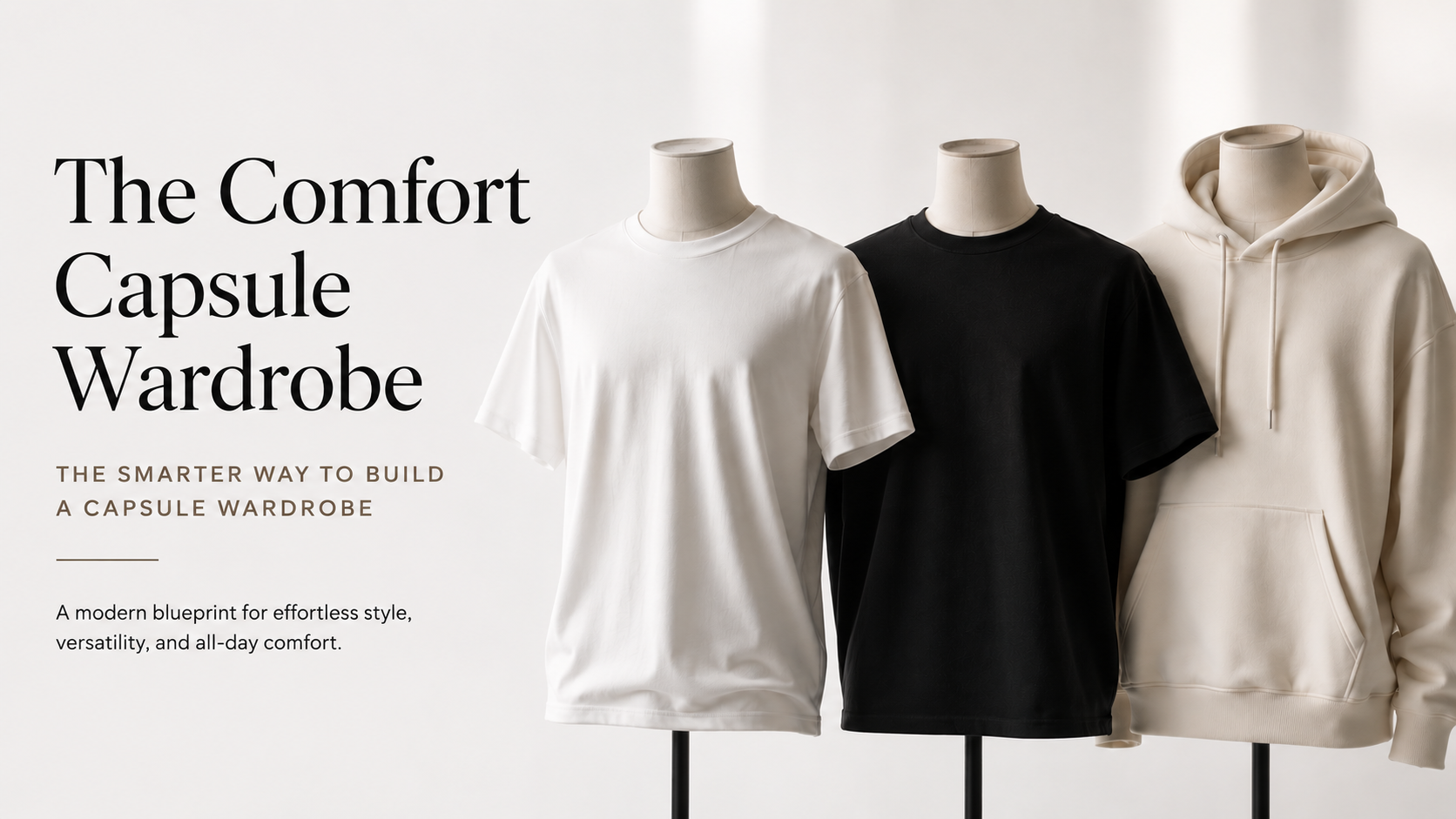
Every capsule wardrobe guide says the same thing: start with neutrals, keep the palette simple, mix and match everything. None of them explain why a closet full of perfectly coordinated black and beige can still feel wrong by two in the afternoon.
The problem was never the color. It’s that comfort was never actually part of the design — it was a filter applied at the end, a soft “would I be okay in this?” tacked onto a system built around palette and piece count. Two black T-shirts in the exact same shade can behave like completely different garments once you’ve had them on for six hours. Comfort isn’t a color decision. It’s a set of physical ones — fabric weight, structure, cut — and none of the popular capsule frameworks build around them directly.
This one does.
Why Comfort Gets Treated as an Afterthought
Open any capsule wardrobe guide and the instructions are almost identical: choose a neutral palette, pick one or two accent colors, cover your key occasions, land somewhere between 20 and 40 pieces. Comfort shows up in the language — “look for pieces that feel good,” “don’t sacrifice comfort for style” — but it’s never the organizing principle. It’s a vibe check applied after the real decisions, color and category and occasion, have already been made.
That ordering is backwards. Color tells you whether two things will match. It tells you nothing about how a garment will feel by hour six, whether it’ll hold its shape through a wash cycle, or whether you’ll actually reach for it on a day that matters. Fabric weight and cut answer those questions. Color doesn’t.
This is also why so many capsule wardrobes quietly fail within a season. Twenty-five well-matched pieces sound efficient on paper, but if only six of them actually feel good against skin by the third wearing, the other nineteen just take up hanger space with better coordination. A capsule isn’t measured by how well it photographs on day one. It’s measured by how much of it is still in rotation by week six.
The Neutral Trap
Here’s what most guides miss: two garments in identical colors can have almost nothing else in common. A black T-shirt at roughly 160 grams per square meter — light, breathable, made to disappear under a layer — behaves nothing like a black T-shirt at 260 GSM, which holds a cleaner line on its own and reads more put-together without any styling effort at all. Sorted by color, they look interchangeable on a hanger. Worn back to back, they aren’t.
The difference shows up in more than feel, too. A lighter weave drapes and moves with the body; a denser one holds a defined edge at the shoulder and hem and stays put through the day. Neither is wrong — they just aren’t interchangeable, and color was never going to tell you which one you were getting.
Building a wardrobe around neutrals solves the outfit-matching problem. It does nothing for the “why does this still feel off” problem, because that was never a color problem to begin with.
The Weight-Fit Framework
A comfort-first capsule needs two axes instead of one: weight — how heavy and structured the fabric is — and fit — how the garment sits on the body. Together, these two variables decide almost everything that matters about how a piece performs across a real day, and they’re also what determines whether pieces from different categories will actually layer together, which is the entire point of a capsule.
Three weight classes
Light — roughly 150–180 GSM. Jersey-weight cotton, the kind used in a Supima T-shirt. Breathes easily, moves without resistance, and is built to sit under something heavier without adding bulk. This is your innermost layer, your warm-day piece, the one that should feel like almost nothing.
Mid — roughly 220–260 GSM. Structured cotton and French Terry live here. This weight class holds a clean line on its own — it reads intentional without any effort, works solo on a normal day, and layers cleanly under something heavier when weather or occasion asks for it.
Heavy — roughly 300–400 GSM. Fleece-class fabric — hoodies, sweatshirts. This is presence weight. It anchors an outfit instead of filling a gap in one, holds structure through a full day of wear, and is usually the piece people compliment without being able to say exactly why it looks better than a thinner version of the same silhouette.
Three fit categories
Regular. Sits close to the body without gripping it. The most neutral read of the three, and it works layered under or over other pieces without fighting them for space.
Relaxed or oversized. Dropped shoulder, more room through the body, a deliberate drape. This fit reads casual no matter what weight class it’s paired with — a heavyweight oversized hoodie says something entirely different from a light oversized T-shirt, even though both are technically “oversized.”
Fitted. Closer to the body, usually with some stretch built in. Reads intentional rather than casual, and works best as a solo piece or as a base layer under something more structured.
Fit carries its own timeline, separate from fabric. A well-proportioned relaxed piece tends to stay wearable for years; a fitted one is more exposed to how your body and your taste both shift over time — CozyVora’s breakdown of that specific tradeoff is worth a look if it changes how you’d weight the grid below.
Weight and fit are independent of each other. A piece can be light and fitted, heavy and relaxed, or anything in between — nine possible combinations in theory. Nobody needs all nine. The framework isn’t about buying into every combination; it’s about knowing which handful you actually reach for, instead of guessing by color and hoping the comfort part sorts itself out.
Reading Weight Without a Label
Most product pages don’t state GSM, which makes the framework harder to use mid-shop than it should be. Two workarounds close that gap. Hold the fabric up to light — if you can see the shadow of your hand through it, it’s light-class. Scrunch a sleeve in your fist and let go: light fabric springs back loose, mid-weight holds a soft crease for a second, heavy fabric holds its shape almost like it’s been pressed. Where the number is actually available, use it instead of guessing — CozyVora, for one, shows the GSM as a badge right on the product page, alongside fit and dispatch details, so it’s visible before you ever have to dig through the full description.
Building the Grid
Most capsule guides count pieces by category — five tops, three bottoms, two jackets. Count by weight class instead, because weight class is what determines whether pieces genuinely work together across a week, not just on a hanger.
A comfort capsule built this way tends to land smaller than the usual advice, not bigger:
- Light layer — 3 to 4 pieces. Your daily foundation. The piece you reach for without thinking, and the one you’ll wear most often, so it earns the highest count.
- Mid layer — 3 to 4 pieces. The pieces that do double duty — worn alone on an ordinary day, worn under something heavier when the day asks for more. A structured 240–260 GSM T-shirt, the weight class CozyVora’s Premium Oversized T-shirts sit in, is usually the hardest-working item in this category: heavy enough to hold its shape through eight hours, light enough to sit under a hoodie without adding bulk.
- Heavy layer — 2 to 3 pieces. Fewer needed here, because a well-made heavy piece gets re-worn without reading as repetitive. Texture and structure register as intentional in a way a repeated print never does.
- Bottoms — 2 to 3 pieces, mixing regular and relaxed fits. Joggers and sweatpants belong on this list now, not as a home-only exception but as a legitimate bottom for actual days out.
That’s somewhere between 12 and 16 pieces total — fewer than the 20 to 30 most guides recommend, because the weight-fit system removes the redundancy that color-only sorting creates. You stop buying a fourth slightly-different black T-shirt hoping this one finally feels right. And because every piece is chosen to layer with at least two others rather than just match them, twelve to sixteen pieces built this way still produce more genuine outfit combinations than a twenty-five-piece wardrobe sorted by color alone.
Weather Doesn’t Require a Different Wardrobe — Just a Different Ratio
Most capsule guides treat seasonal change as a wholesale swap: pack one wardrobe away, unpack another. A weight-based capsule doesn’t need that, because the three categories already exist year-round — only the proportion shifts. Warmer stretches lean harder on the light layer, worn alone or under nothing at all. Cooler stretches lean on the heavy layer, sometimes stacked over a mid-weight piece instead of a light one, which is where a lot of the framework’s actual versatility shows up: the same mid-weight T-shirt that stands alone in October becomes a base layer in December.
Travel works on the same logic. A weight-based capsule packs by role rather than by outfit, so a four-day trip might mean two light pieces, one mid, and one heavy instead of four separate looks — because the mid and heavy pieces can be re-worn without reading as repetition the way a fourth identical color-matched top would.
The 20-Minute Test — Audit Before You Buy
Before shopping for anything new, run what’s already in the closet through the grid above. Most decluttering advice asks whether a piece sparks joy, or whether you’d buy it again. Neither question tells you anything about comfort. Try this instead: put the piece on, then check in after twenty minutes.
If you’re still aware of it — a waistband that’s started digging in, a sleeve that keeps riding up, fabric clinging somewhere it shouldn’t — it fails, regardless of how good it looked in the mirror at minute zero. If you’ve genuinely forgotten you’re wearing it, it stays. A comfort capsule should pass this test before it’s ever asked to pass a color-matching one.
Whatever survives gets sorted into a weight-and-fit slot from the grid above. Whatever’s left on the floor after twenty minutes is the real shopping list — a specific gap the grid can name, not a mood board.
Comfort Doesn’t Mean Shapeless
The usual worry with a comfort-first wardrobe is that it’ll read as underdressed — sweatshirt energy in a room that expects a collar. That worry is really about thin fabric, not comfort itself. A heavyweight hoodie at 300–400 GSM holds a cleaner silhouette than a thin one that starts drooping by midmorning; structure comes from fabric weight and construction, not from stiffness or tailoring alone. It’s the whole case for pairing comfort with elegance instead of treating them as opposites, something CozyVora has argued at length — and it holds up because weight and fit are doing the structural work, not forced tailoring.
Caring for a Comfort Capsule
A smaller, weight-driven wardrobe only works if the pieces last, since there’s less to rotate through if one wears out early. A few habits protect the investment: wash cold, skip fabric softener on anything fleece-based since it clogs the fibers that keep the fabric warm, air dry where possible instead of high heat, and turn printed pieces inside out before washing or ironing. None of it is complicated. It’s the difference between a piece that softens over time and one that just thins out.
The Takeaway
Most capsule wardrobe advice asks you to sort by color and hope comfort follows. Sort by weight and fit instead, and comfort stops being something you check for after the fact — it becomes the reason the wardrobe works in the first place.
If the light or mid layer is where your own closet runs thin, that’s usually the easiest gap to close first. CozyVora’s Essentials line spans exactly this range — from 160 GSM Supima T-shirts up through 300+ GSM hoodies — which makes it a reasonable place to start comparing, even if you end up buying elsewhere.
FAQ
How many pieces does a comfort capsule wardrobe actually need?
Somewhere between 12 and 16, if you’re building by weight class rather than by color or occasion. That’s fewer than most capsule guides suggest, because sorting by how fabric behaves removes the redundant near-duplicates that color-only sorting tends to produce.
What fabric weight is best for everyday comfort?
There isn’t one answer — it depends on the role the piece plays. Light fabric, roughly 150–180 GSM, works as a base layer or warm-weather piece. Mid-weight fabric, roughly 220–260 GSM, is the most versatile single category, holding its own solo or layered. Heavy fabric at 300 GSM and up is for pieces meant to anchor an outfit rather than fill a gap in one.
Will a comfort-first wardrobe still look appropriate for work or going out?
Yes, as long as weight and fit are chosen on purpose rather than by default. A structured mid-weight piece in a regular or fitted cut reads as put-together; it’s specifically thin, stretched-out fabric in an oversized cut that tends to read as underdressed. The weight-fit framework exists to keep that choice deliberate instead of accidental.
How do you know when it’s time to replace a piece?
Watch the fabric, not the color. Thinning, pilling that won’t brush out, and a loss of shape after washing are the real signs, not fading, which happens to almost everything eventually. Heavier-GSM fabric tends to show these signs more slowly than lighter fabric simply because there’s more fiber holding the structure together.


Leave a Reply