

You didn’t lose ten minutes standing in front of your closet this morning. You lost a slice of the sharpest hour of your day to a decision that never needed to be one.
Wardrobe-planning communities have spent the last few years shifting focus: away from “what should I buy” and toward “what should I never have to think about again.” That shift shows up in one recurring idea: build a small number of outfit formulas, not an ever-growing closet of options.
The 5-Outfit Uniform System takes that idea and gives it actual structure. Not one outfit worn on repeat, but five, each built for a specific kind of day, each with exactly one variable you’re allowed to change. Everything else is already decided before you’re awake enough to decide it.
What “Uniform” Actually Gets Wrong
Every article on this topic eventually invokes decision fatigue, the term social psychologist Roy Baumeister coined for the way judgment quietly erodes after a long string of choices, however small. It’s a real, well-documented phenomenon. It’s also frequently stretched further than the original research supports.
The studies behind the concept looked at things like resisting sustained temptation or making high-stakes calls late in a long shift. Not picking between two T-shirts you already own and already like. Psychologists who study decision fatigue are often the first to note that everyday wardrobe choices aren’t quite operating in the same register.
So here’s the more honest version: five fixed formulas won’t preserve your executive function for the decisions that actually matter at work. What they save is smaller and more useful: the two or three minutes of low-grade friction every morning where you second-guess a pairing, check the mirror twice, and start the day slightly behind it.
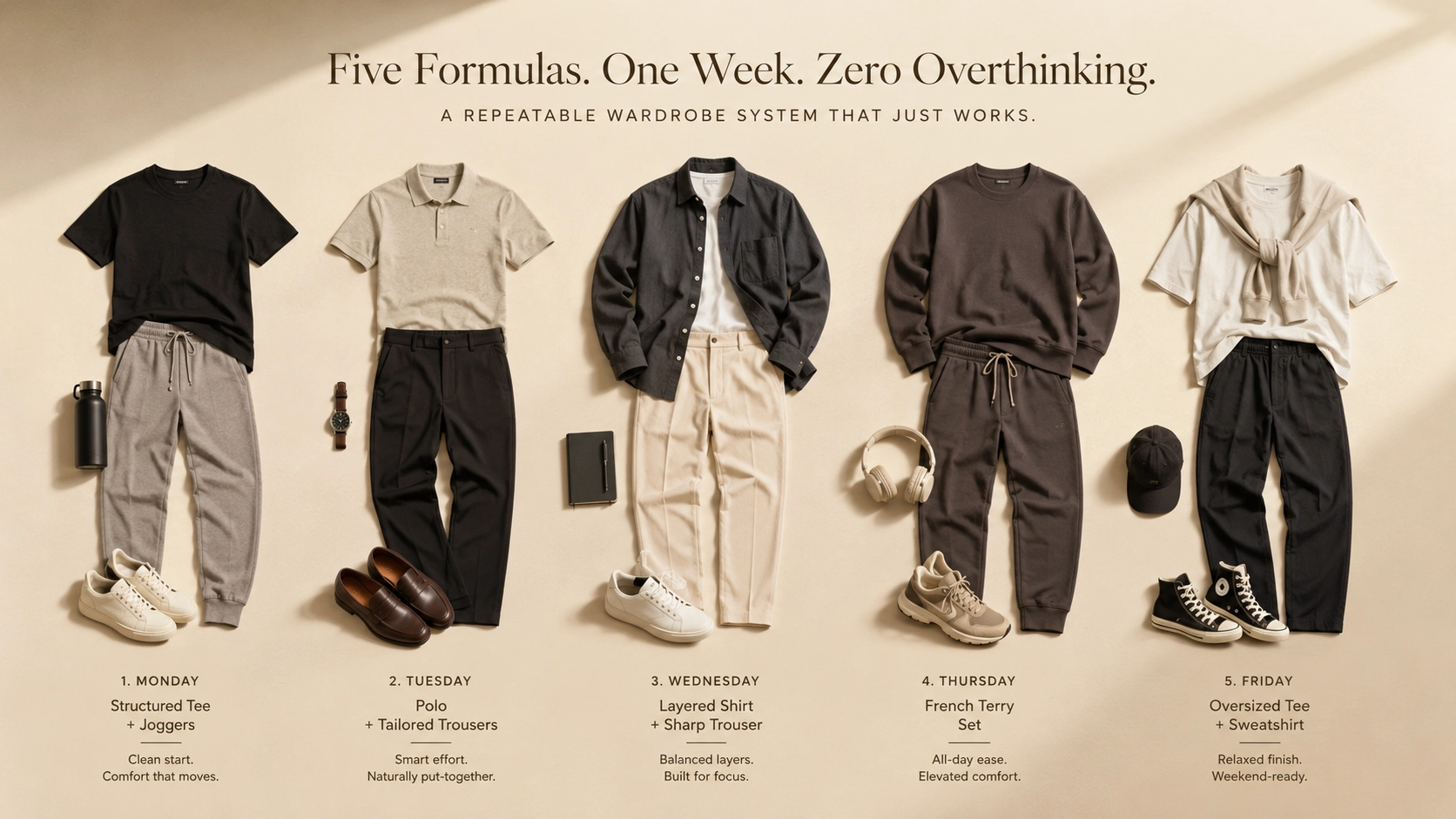
The System: Five Formulas, One Swap Each
A uniform in the Steve Jobs sense is one outfit, forever. That works only if your week doesn’t change shape. Most professional weeks do. A heads-down day looks nothing like a client pitch, and dressing for both the same way either overdresses the desk or underdresses the room.
It solves for that variation instead of ignoring it. Each formula is fixed except for a single swap slot: a color, a layer, or a texture. That’s what gets you five real answers to “what do I wear,” not fifty ways to reconsider the same five.
1. The Deep-Work Day
Structured tee + joggers or sweatpants + your softest layer. You’re not really leaving your desk on this one. Prioritize a fabric heavy enough to hold its shape on video calls but soft enough to disappear by hour four. A heavier cotton tee drapes with more structure on camera than a light, thin one does. Swap slot: the outer layer, rotating between a hoodie and an open shirt depending on the room.
2. The In-Office Day
Polo or structured T-shirt + tailored joggers or straight trousers + clean sneakers. Enough shape to read as intentional at a desk, enough ease that you’re not adjusting a collar by 2 PM. This is where “comfortable” dressing quietly fails most often: soft fabric that loses its line by midday reads as rumpled, not relaxed. Swap slot: the bottom, alternating between two neutral trousers so the formula doesn’t feel identical two days running.
3. The High-Stakes Day
Structured shirt or layered oversized tee + a sharper trouser + your one elevated piece. Reserve one formula for the day that actually needs more presence: a pitch, a review, a first meeting. The swap slot here is deliberate, one piece rotated specifically for these days, so it keeps feeling considered instead of routine. Weight matters most in this formula; heavier fabric holds a line under office lighting in a way thin cotton doesn’t.
4. The Transit Day
French Terry pieces + a layered top + shoes built for movement. Built for the day that moves: between a train, two meetings in different buildings, a flight. Wrinkle resistance and shape retention matter more here than anywhere else in the system; fabric that creases under a bag strap by 10 AM undoes the point of dressing once. Swap slot: the bag or outer layer, since that’s what actually changes across a transit-heavy week.
5. The Wind-Down Day
Oversized tee or sweatshirt + relaxed bottoms + your most-worn shoes. For the day that blurs: errands, a late dinner, a Saturday that still has a work call sitting in it somewhere. This is the formula CozyVora’s oversized tees and structured sweatshirts are actually built for: heavy enough to feel substantial, relaxed enough to disappear into. It should feel like the reward at the end of the other four, not a lesser version of them. Swap slot: color, since this is the formula you’ll reach for most.
Your Five at a Glance
| Day | Formula | Swap Slot |
|---|---|---|
| Deep-Work | Structured tee + joggers or sweatpants + soft layer | Outer layer |
| In-Office | Polo or structured tee + tailored joggers or trousers + sneakers | Bottom |
| High-Stakes | Structured shirt or layered tee + sharp trouser + elevated piece | The elevated piece |
| Transit | French Terry pieces + layered top + movement-ready shoes | Bag or outer layer |
| Wind-Down | Oversized tee or sweatshirt + relaxed bottoms + most-worn shoes | Color |
Why Five, and Not One or Fifteen
One outfit works only if every day of your week asks the same thing of you. Fifteen outfits reintroduces exactly the problem you’re trying to solve. You’re back to standing in front of open options, just better ones.
Five sits at the number where most professional weeks actually vary: a heads-down day, an in-person day, an occasional high-stakes day, a moving-around day, and the day that isn’t really a workday at all. Fewer than that, and you’re forcing two genuinely different contexts into one formula. Wearing a desk outfit to a client meeting comes across as underdressed, not efficient. More than that, and you’ve rebuilt a small capsule wardrobe with extra steps, minus the actual variety a capsule is supposed to offer.
If your week has a sixth recurring context (travel, a second job, a caregiving schedule), the system still holds. Add a sixth formula. The number five isn’t sacred. The one-swap-slot rule is.
How to Build Your Actual Five
Don’t start by shopping. Start by auditing what already gets worn.
Pull the outfits you’ve actually repeated most in the last month: not the ones hanging cleanest in the closet, but the ones you’ve reached for again and again. That’s your real uniform, already half-built by habit. Most people find they’re already running an accidental three-formula system; the work is filling the other two contexts deliberately instead of improvising them every morning.
Map your actual week next. The five contexts above cover most professional schedules, but yours might not split evenly. Never client-facing? The High-Stakes formula becomes a slightly sharper version of In-Office. No commute between locations? Fold Transit into whichever day involves the most movement.
Once you know your five contexts, build backward from fabric weight, not color. CozyVora’s structured tees run in the 240–260 GSM range, for reference. That’s heavy enough to keep its structure through a nine-hour day, which matters more for In-Office and High-Stakes than it does for Wind-Down, where drape matters more than structure. Buy for the day the formula needs to survive, not the version you like best in a mirror.
Then commit to the swap slot, and only the swap slot. The moment a second variable creeps in, a different bottom and a different top on the same day, you’ve recreated the decision tree this whole system was meant to remove.
When a Formula Stops Working
Most guides stop at “build it.” Few cover what happens six weeks later, when one of your five formulas quietly stops getting worn.
That’s not failure. It’s data. A formula you’re avoiding is usually telling you one of three things: the fabric weight is wrong for that day’s actual temperature or activity level, the swap slot doesn’t have enough real options in it, or the context itself doesn’t come up as often as you assumed when you built the system. Fix the mismatch, not your discipline. Skipping the Transit formula every time probably means you don’t need five categories: you need four, plus a slightly wider swap slot on the one covering two jobs.
Rebuild once a season, not once a year. Fabric weight that felt right in March won’t feel right by July, and a system that doesn’t flex with weather isn’t actually reducing decisions. It’s just delaying the ones you’re avoiding.
The Takeaway
The goal was never to dress identically. It was to stop re-deciding the same five outfits every single morning. Build the formulas once, and the only real decision left is which day you’re actually having.
FAQ
Won’t I get bored wearing similar outfits constantly?
Less than you’d expect, because the system isn’t asking you to repeat one outfit: it’s giving you five, each built for a distinctly different kind of day. The boredom people associate with “uniform dressing” usually comes from the single-outfit version, not a five-formula system with a real swap slot in each one.
How many actual pieces do I need to run this?
Fewer than a traditional capsule wardrobe, because you’re not aiming for maximum combinations: you’re aiming for five fixed answers. Most people can run the full system on 10 to 14 pieces: one or two tops and one bottom per formula, plus whatever sits in each swap slot.
What if my week doesn’t match these five categories?
Rename them. The five contexts here map to a common professional week, but the underlying structure (fixed formula, one swap slot, built around fabric weight) transfers to any schedule. Swap “Transit” for “Parent Day” or “Field Day” if that’s what actually recurs in your week.
Does this work on video calls, where people see the same outfit repeatedly?
It works better than most alternatives, because a five-formula system still gives you five distinct looks across a week, not one. The In-Office and High-Stakes formulas are built with camera-readability in mind for exactly this reason: structure holds up on screen in a way soft, shapeless layers don’t.


Leave a Reply