

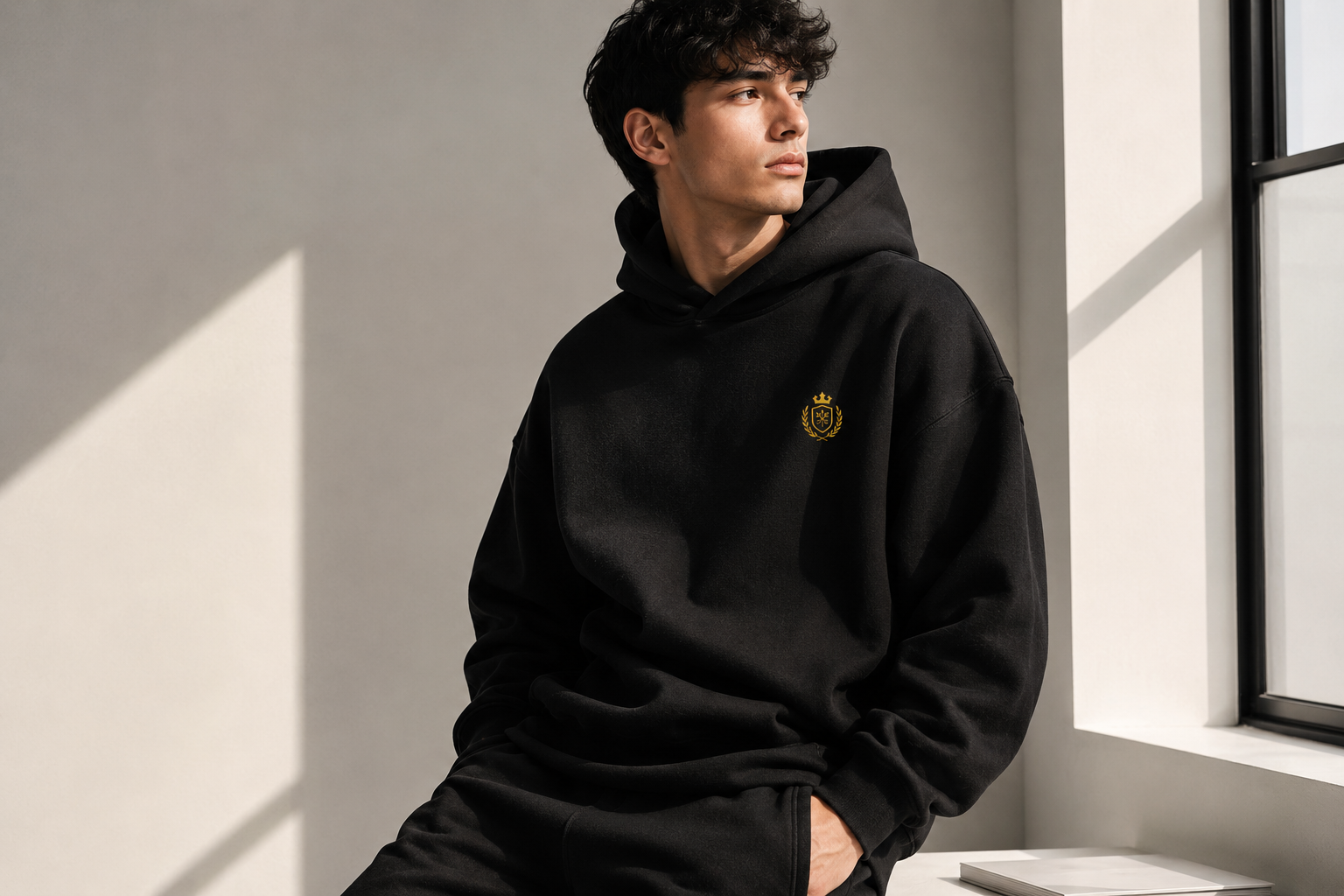
The first time you put on something deliberately too big, something happens before you even find a mirror: you stop adjusting. No tugging a hem down, no holding your stomach in, no shifting a waistband that’s cutting into your side. That absence is the small, constant editing most fitted clothing usually asks of you, and it’s doing more for how you carry yourself than the extra fabric ever will.
“It’s just a trend” stopped explaining anything a while ago. This silhouette has held its dominance too long for that read to survive. What’s less understood is why it changes how people feel in their own skin, and why some oversized outfits read as effortless while others just look like someone borrowed their sibling’s hoodie. Both use more fabric than the fitted alternative. Only one is doing something for the wearer’s head.
What’s Actually Happening When You Stop Thinking About Your Clothes
Psychologists have spent decades studying something adjacent to this exact feeling. It’s called self-objectification, the mental habit of monitoring how your body looks from the outside, as if you’re watching yourself through someone else’s eyes. Barbara Fredrickson and Tomi-Ann Roberts, the researchers who first mapped this out in the 1990s, found that this kind of appearance-monitoring isn’t free. It uses real mental bandwidth. In one well-known experiment, women who tried on a swimsuit and then took a math test scored worse than women who took the same test in a sweater, not because the swimsuit made anyone worse at math, but because part of their attention was occupied elsewhere, managing how their body looked and felt.
Fitted clothing, tight waistbands, anything that asks for constant small corrections, can trigger a milder version of the same thing. You don’t consciously register it as “monitoring my appearance.” It shows up as fidgeting, a background hum of self-consciousness, a harder time being fully present in a conversation or a room you just walked into.
Picture sitting through a two-hour lecture in something that keeps riding up at the waist, versus something that just sits there, forgotten. One version of you spends the lecture half-listening, half-managing a waistband. The other version just listens. Neither required more focus. The second one simply had less friction to manage in the first place.
Take that background task away, genuinely away and not just hidden under looser fabric, and the mental space it was using becomes available for something else. That’s the part that actually changes how you carry yourself. Not the silhouette. The absence of a job your brain no longer has to do.
There’s a related, newer idea researchers call enclothed cognition: the observation that clothing doesn’t just communicate something to other people, it can shift how the wearer thinks and behaves, through a mix of what the clothing symbolizes and what it physically feels like to wear it. It’s a more debated area of study than objectification theory, and not every specific finding from it has held up cleanly under closer testing. But the broader principle, that what’s on your body changes what’s going on in your head and not just how you look to others, lines up with what oversized dressing seems to do for a lot of people.
It’s Not the Size. It’s What You Stop Doing.
Most explanations of oversized fashion stop short right here. They frame it as rebellion: a rejection of “fit culture,” a body-positivity statement, a generational pushback against tailored expectations. That’s part of the story. But treating the effect as purely social, something you’re doing at other people, misses how quiet it actually is for a lot of wearers. It’s not a statement. It’s relief.
That relief may hit differently for people who’ve grown up documented constantly: tagged in photos, visible in group chats, aware that almost any outfit could end up on someone’s camera roll. If appearance-monitoring is already elevated by that kind of constant, low-grade visibility, then clothing that switches it off does more work than it would have a generation ago. It’s not that older generations didn’t feel comfort in loose clothes. It’s that the baseline level of self-monitoring oversized dressing is switching off may simply be higher now.
When a garment isn’t asking you to hold a shape, monitor a hemline, or worry about a seam sitting wrong, your attention gets to go somewhere else: the conversation you’re having, the work in front of you, the room itself. People read that redirected attention as ease. Ease reads as confidence. You didn’t do anything to perform confidence. You stopped performing self-management, and what was left looked like it.
The Part Most Advice Skips: Oversized Can Undo Confidence, Too
Here’s the piece that gets left out of almost every “oversized equals confidence” take: size alone doesn’t guarantee any of this. Wear something so large it swallows your frame entirely, with no shape, no shoulder line, no sense of where your body actually is inside the fabric, and the effect can flip. Instead of feeling unbothered, you feel shapeless. Instead of presence, you get lost in it.
The difference isn’t a matter of degree. It’s not “less oversized is safer.” It’s a matter of structure. A garment that’s oversized with intention still tells the eye where the shoulders are, still has a drape that moves with the body instead of just hanging off it. A garment that’s oversized by accident, too thin, too shapeless, cut with no attention to how it actually falls, just reads as clothes that don’t fit. One gives you the mental quiet this whole effect depends on. The other adds a new kind of self-consciousness: do I look put together, or do I look like I got dressed in the dark.
This is the tension nobody selling the trend wants to name out loud: oversized isn’t automatically a shortcut to confidence. Oversized built with structure is. Everything else is just loose.
Why Weight and Drape Do More Than Size Ever Will
Structure comes from fabric, not only from cut. Heavier material, a structured 240–260 GSM cotton in a tee or a denser 300–400 GSM fleece in a hoodie, holds a dropped shoulder the way it’s meant to sit instead of collapsing the moment you move. It’s the difference between a piece that drapes with intention and one that just hangs there. CozyVora builds its oversized pieces, like the Terry Oversized Tee, the Oversized Hoodie, and the UC22 Oversized T-shirt, around exactly that: dropped shoulders, roomy sleeves, a controlled drape, rather than simply sizing an existing shape up. The goal isn’t more fabric for its own sake. It’s presence without bulk: volume that still reads as chosen.
If you want the sharper, more structured version of oversized, your usual size does that. If you want fuller, more relaxed volume, sizing up is the move. Either way, the fabric’s weight is doing quiet work you’ll never consciously register, until you wear something too thin to do it, and the whole silhouette falls flat instead of holding its shape.
Wearing Oversized With Intention: A Few Actual Anchors
The fastest way to keep an oversized piece from reading as sloppy is to give the eye one place to land. A few ways to do that:
- Anchor one point. If the top is loose, let something else sit close: fitted bottoms, a cinched waist, or cuffs rolled to show the wrist. One fitted element tells the eye the volume elsewhere is a choice, not an accident.
- Respect proportion, not just size. Oversized on top pairs naturally with something narrower below, and the reverse works too. Two loose pieces worn together can blur into shapelessness fast.
- Let the hem do the framing. A hoodie left long and untouched reads differently than one half-tucked at the front. The second gives the outfit a waistline again without losing the volume.
- Ground it with footwear. A bulkier top reads as intentional next to something more defined on your feet. It gives the silhouette a bottom edge to rest on instead of trailing off.
None of this shrinks the volume. It gives the outfit a structure your eye can follow, so the looseness reads as a decision instead of an oversight.
When to Reach for Something Fitted Instead
Oversized isn’t a universal confidence setting. Some days, and some rooms, call for the opposite: a fitted silhouette that makes you feel sharp, contained, ready to move fast. The underlying mechanism doesn’t change either way: the goal was never a specific size, it’s clothing that isn’t asking anything of your attention. For some people, in some contexts, that’s a roomy hoodie. For others, it’s a clean, fitted tee sitting exactly where it should. That’s the same idea CozyVora’s regular-fit pieces are built on, sitting close to the body without ever restricting movement, so a fitted tee does for a sharper day what an oversized hoodie does for a slower one. Same mechanism, different shape. Confidence isn’t a silhouette. It’s the absence of static.
The One Thing Worth Remembering
Oversized clothing doesn’t create confidence by covering you up. It creates confidence by giving your brain one less thing to manage. That only works when the piece is built to hold its shape without your help, which means the real decision was never about size. It was always about structure.
Explore CozyVora Essentials
Built to hold its shape, so you don’t have to.
👉 Explore CozyVora’s oversized edit
- Read Next: Oversized Vs Slim Fit: The 5-Year Test
- Read Next: Why Loud Fashion Is Fading (And Quiet Confidence Is Rising)
FAQ
Does wearing oversized clothes actually make you more confident, or does it just feel that way in the moment?
Both, depending on how the garment is built. The underlying mechanism, less appearance-monitoring and more attention free for everything else, is well documented in psychology research on self-consciousness and cognitive load. But that effect depends on the clothing genuinely removing friction, not just adding size. A shapeless fit that makes you self-conscious about looking sloppy can cancel the benefit out entirely.
Why do oversized clothes feel calming even before you leave the house?
Loose, non-restrictive clothing removes the small physical frictions that would otherwise sit in the back of your mind all day: a tight waistband, a pulling seam, a hem you keep adjusting. Removing that background task tends to register as calm, even before you can point to exactly why.
What’s the actual difference between “oversized” and just wearing something too big?
Structure. Oversized clothing built with intention reads as a choice: a defined shoulder line, fabric with enough weight to hold its drape, a silhouette that still shows where your body is. Something too big with no shape or shoulder definition just reads as ill-fitting, regardless of the size on the label.
Can oversized clothing look put-together in a professional or formal-adjacent setting?
Yes, with the right anchor points. Pairing a looser top with something more fitted below, keeping footwear clean and defined, and choosing a heavier fabric that holds its shape all push an oversized piece toward considered rather than borrowed. The silhouette can flex; the structure is what keeps it from reading as careless.


Leave a Reply